
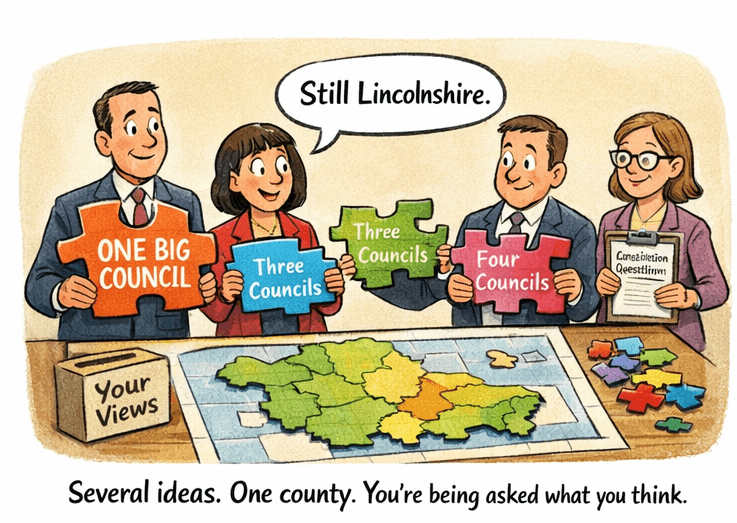
The UK government has opened a statutory consultation on proposed changes to the structure of local government in Lincolnshire, North Lincolnshire and North East Lincolnshire. The consultation launched on 5 February 2026 and runs until 11:59pm on 26 March 2026. It seeks views on a set of reorganisation proposals submitted by councils across the area.
The consultation is being led by the Ministry of Housing, Communities and Local Government (MHCLG). Its focus is on whether one of the proposed models for creating new unitary councils should be taken forward, modified or rejected. Responses from residents, businesses, parish and town councils, public bodies, and other stakeholders will help shape the government’s final decision.
What This Is About
Lincolnshire currently has a two-tier local government system in most of the county. This means services are split between Lincolnshire County Council and seven district or borough councils. In contrast, North Lincolnshire and North East Lincolnshire are already unitary councils, responsible for all local government services in their areas.
The government’s aim with reorganisation is to simplify and strengthen local government arrangements by replacing the two-tier model with new single-tier (unitary) councils. According to the consultation documents, such reforms are intended to:
- Give the local government clearer responsibility for services
- improve direct accountability
- reduce duplication and drive efficiencies
- support future investment and strategic planning.
The Proposals Being Consulted On
Councils across the area submitted four different proposals to the government by 28 November 2025. These are summarised in the consultation and reflect a range of ideas for unitary structures covering the existing local authority areas.
- The two-unitary council model was proposed by Boston Borough, East Lindsey, and South Holland councils. It would see one new northern council covering Lincoln, North East Lincolnshire, North Lincolnshire and West Lindsey, and a southern council co vering Boston, East Lindsey, South Holland, North Kesteven and South Kesteven.
- Four-unitary council model from the City of Lincoln Council, including a separate Lincoln city authority and a rural unitary alongside the existing North Lincolnshire and North East Lincolnshire unitary councils.
- The three-unitary councils proposal supported by Lincolnshire County Council (and colleagues in North Lincolnshire and North East Lincolnshire). In this model, North and North East Lincolnshire would remain unchanged as unitary authorities, with a single unitary council covering the rest of Lincolnshire.
- Four councils’ proposal from North Kesteven and South Kesteven councils, proposing two new unitary authorities for the central county area, plus the existing two northern unitary areas unchanged.
West Lindsey District Council did not formally submit a proposal.
How to Take Part
The consultation invites responses on each proposal. Participants can answer structured questions on the geographic logic of proposals, service delivery outcomes, financial resilience, service quality, local engagement, support for devolution structures, and community empowerment. There are also free text sections for further comments.
Responses can be submitted:
- online through the government’s consultation portal: https://consult.communities.gov.uk/local-government-reorganisation/lincolnshire-nlincolnshire-nelincolnshire
- by email to LGRconsultationresponse@communities.gov.uk
- by post to the MHCLG consultation team in London: LGR Consultation, Fry Building 2NE, Ministry of Housing, Communities and Local Government, 2 Marsham Street, London, SW1P 4DF
What Happens Next
Once the consultation closes, the Secretary of State will review responses alongside the submitted proposals. Officials will assess how well each proposal meets statutory criteria, including geographic sense, service capability, financial sustainability and community engagement. Any final decision will be subject to Parliamentary approval.
If new unitary councils are agreed, the earliest timeframe set out in government documents anticipates shadow authorities operating in 2027 and new councils assuming full responsibilities in April 2028.


I would like to know if it 123 or 4 how does it affect council staffing levels ?
Unless you can prove savings above 20%, leave as is.