
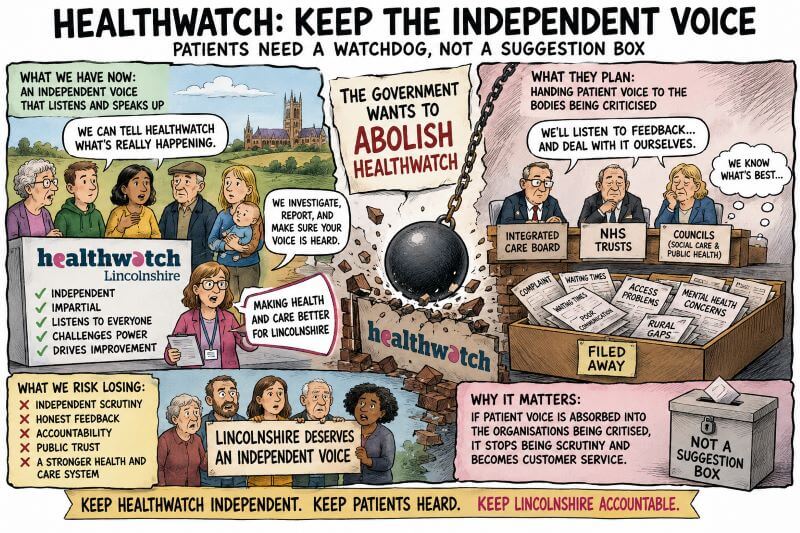
The Government’s latest Health Bill takes a wrecking ball to one of the few genuinely independent patient voices left in the NHS.
Buried inside the reforms is a proposal to abolish Healthwatch England and the network of local Healthwatch organisations, including Healthwatch Lincolnshire. Ministers call it “streamlining”. In reality, it hands patient feedback back to the same institutions being criticised.
That is not accountability. That is self-assessment.
Lincolnshire knows why independence matters
For years, Healthwatch Lincolnshire has operated separately from both the NHS and local government. That separation matters.
Residents speak openly because they know their concerns are not being filtered through NHS management structures or council communications teams. Families raise issues around GP access, ambulance delays, mental health provision, discharge failures and rural isolation because they trust someone independent is listening.
In a county as large and scattered as Lincolnshire, that role carries real weight. Coastal communities, isolated villages and older residents often struggle hardest to access services. An independent body has been able to gather those experiences and force uncomfortable conversations into the open.
The Government now wants those functions absorbed into Integrated Care Boards, NHS organisations and councils themselves.
The bodies being criticised would become the bodies collecting, interpreting and responding to complaints.
That is marking your own homework.
The danger is obvious
Every institution protects itself. That is human nature and organisational instinct.
Without independent scrutiny, bad news gets softened. Failure becomes “learning”. Delays become “pressures”. Complaints become “engagement feedback”.
The NHS already struggles with public confidence after years of waiting list growth, access problems and inconsistent standards. Removing independent challenge now sends entirely the wrong message.
Patient voice only works when patients believe someone external is prepared to ask difficult questions.
Once that independence disappears, trust goes with it.
Lincolnshire already built Healthwatch into scrutiny
This is not some optional side project.
Lincolnshire County Council’s own constitution formally recognises Healthwatch within its scrutiny system. The Health Scrutiny Committee for Lincolnshire includes a representative nominated by Healthwatch Lincolnshire and specifically references liaison and referrals from the organisation.
The Adults and Community Wellbeing Scrutiny Committee also has a formal requirement to liaise with Healthwatch Lincolnshire and consider referrals from it.
The council constitution itself states that scrutiny exists to create “a powerful and effective means of holding decision-makers to public account.”
The Government is now moving in the opposite direction.
What gets lost
Healthwatch organisations do more than process complaints.
They carry out enter-and-view visits. They identify patterns across services. They reach vulnerable groups who rarely engage with formal consultation exercises. They challenge commissioners and providers publicly when standards fall short.
Most importantly, they are independent enough to say things powerful organisations may not want to hear.
That independence cannot simply be recreated by creating another NHS department or council team.
Patient voice is not independent when it sits inside the structure it is supposed to scrutinise.
“Patients need an independent voice”
Lincolnshire Conservatives’ NHS and Public Health spokesman, Cllr Sue Woolley, said:
“Patients need an independent voice that is prepared to challenge powerful organisations when services fall short. Healthwatch has played an important role in making sure local people, carers and vulnerable residents are actually heard.
“If the NHS and councils become responsible for handling scrutiny of their own performance, public confidence will inevitably suffer. Independent challenge is not an inconvenience, it is part of accountability.
“For a large rural county like Lincolnshire, where access to services can already be difficult, removing a trusted independent organisation is a serious mistake.”
A serious mistake
There is a legitimate argument for reducing duplication inside the health system. Nobody disputes the NHS faces financial pressure.
But accountability is not duplication.
Independent scrutiny becomes more important when services are stretched, not less.
The Government should pause this part of the Bill and rethink it properly before another layer of public trust disappears into the machinery of the state.
Healthwatch is not bureaucracy.
It is one of the last mechanisms ordinary patients have to challenge powerful institutions on equal terms.
Once that voice is absorbed into the system itself, getting it back will be far harder.




Recent Comments